Properties for sale in the Vallée du Risse range from traditional Savoyard farmhouses in need of renovation to recently built chalets, apartments and serviced building land. The mix suits most budgets and most plans, whether a primary residence, a holiday home with ski access, or an investment within reach of Geneva. For buyers who want to acquire property in France without resort-town prices, the valley is an accessible alternative to the high-profile towns nearby, quieter than a ski station without losing the access that draws people to the area.
Where is the Vallée du Risse?
The Vallée du Risse runs through the southern Chablais in Haute-Savoie (département 74), between the Risse river and the lower flanks of the Giffre massif, south of Lake Geneva. Its villages (Bons-en-Chablais, Habère-Poche, Habère-Lullin and Vailly) sit at valley level rather than perched in a ski station. East of Thonon-les-Bains and south of the A40 motorway corridor, the valley connects down to Bons-en-Chablais and the autoroute network by the D12 and D22. Geneva airport is 45 to 55 minutes away by car, Annecy around an hour, and the Arve valley around Cluses is reachable in under half an hour from the eastern end.
Altitude is lower than the Arve resorts (Habère-Poche sits at roughly 1,000m), so winters at valley level are milder and the land is open pasture and mixed forest rather than lift infrastructure. The villages are quiet, with local services rather than tourist frontage. For most people buying here, that quiet is the point.
Life in the Vallée du Risse
The valley works as a place to live year-round. Bons-en-Chablais and Habère-Poche carry the everyday shops and services, there are weekly markets, schools at valley level and a medical centre. It does not empty out in May and October the way a single-season resort does, which suits buyers weighing it as a primary residence or a year-round base.
In winter the valley holds snow without the traffic and noise of a ski station. In summer the pasture, the forest tracks and the Risse itself draw walkers and cyclists.
Outdoor activities and ski access
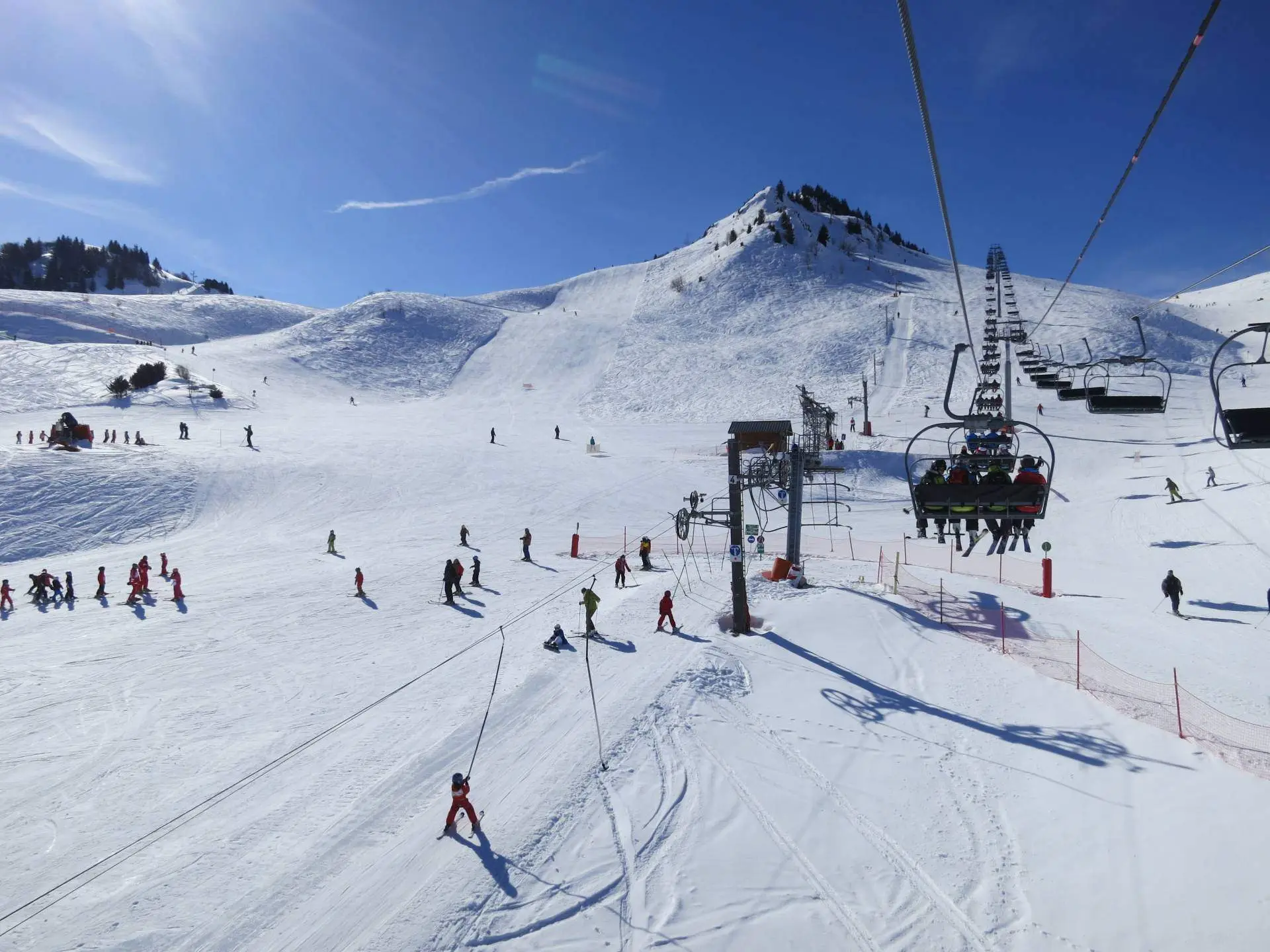
The valley itself is walking and cycling country: forest trails, river paths and open summer pasture. Habère-Poche has a small ski area with a local following, modest in scale and a different proposition from the larger domains. For more serious skiing, Les Gets, Morzine and the full Portes du Soleil are 30 to 40 minutes away by car. The Portes du Soleil is one of the largest linked ski areas in the Alps, so reaching the slopes from a Vallée du Risse property is a practical reality rather than a stretch.
You are not ski-in ski-out from a valley property, but the slopes are close enough for daily access across a season. Buyers who want a quieter base, away from the hotels and the après-ski, often find the short drive worth making.
Property types in the Vallée du Risse
The valley's stock falls broadly into three groups. Traditional Savoyard farmhouses and older chalets make up the historic core, often with outbuildings: a grange, or a separate mazot, the small detached store building common to this part of the Alps. These come with land, character and frequently a garden, but many need extensive work. France's DPE (Diagnostic de Performance Énergétique, the national energy rating) now puts real obligations on older buildings: those rated F or G face restrictions on being let and growing pressure on resale. Anyone considering a traditional farmhouse should budget properly for insulation, heating and windows. Under current rules this is a condition of the property being usable, not an optional upgrade.
More recent building offers the alternative. Detached houses and small developments of chalets and apartments tend to have been built or renovated to current standards, with a DPE rating that needs no immediate remediation. Apartments are available, though the valley leans towards houses with outdoor space rather than apartment-led development. Newer or fully renovated properties are where you find the features short-term renters look for: a swimming pool, sometimes a hammam, a finished interior with a working fireplace.
Serviced building land is a third route, and a popular one. A terrain viabilisé comes with mains connections in place and planning conditions established, and buying a plot to commission a modular or traditional build lets you set the accommodation to your own specification and meet current energy standards from the start. New construction in France carries the garantie décennale, the ten-year structural guarantee, which older stock cannot offer. Land prices in the valley make this financially viable in a way it simply is not in Chamonix or the established resorts.
Property prices in the Vallée du Risse
Detached houses in the Vallée du Risse run broadly from €350,000 to €460,000 for standard stock, with condition, size and position setting where a given property sits in that band. Open views carry a clear premium, and there is steady local demand for properties that look out over the valley or towards the Giffre. A house with a dominant position on the hillside holds its price better than an equivalent set back from the view.
The comparison with Chamonix is plain. Chamonix runs well above €10,000/m² for most residential property, and the gap with Megève and the better-known parts of the Portes du Soleil is similar. The Vallée du Risse sits at the more accessible end of the Haute-Savoie market, the central point in its favour for a buyer who wants the French Alps without a resort budget.
The Vallée du Risse as a property investment
Proximity to Geneva is the foundation of the investment case. Geneva carries some of the highest average salaries in Europe, and cross-border demand for housing on the French side (from Swiss-based buyers and from frontaliers, the workers who commute across the border) has been a constant in the Haute-Savoie market for decades. The valley sits within a reasonable commute and benefits from that demand without the full price premium of the areas closer in.
Rental demand follows two patterns. There is year-round letting to Geneva commuters, and seasonal letting to walkers, cyclists and skiers. A well-placed property with comfortable accommodation, and the outdoor space or swimming pool that short-term renters expect, can earn across several seasons rather than depending on ski weeks alone. Character properties where the renovation has been completed to a high standard tend to command the strongest short-let rates.
On capital growth, the valley has not seen the speculative inflation of Chamonix or Megève, so entry prices are rational and the upside rests on continued Geneva-area demand rather than tourist sentiment. That is probably a steadier footing, though property carries uncertainty no overview can remove. We would not present the valley as a guaranteed growth story. No Alpine market is.