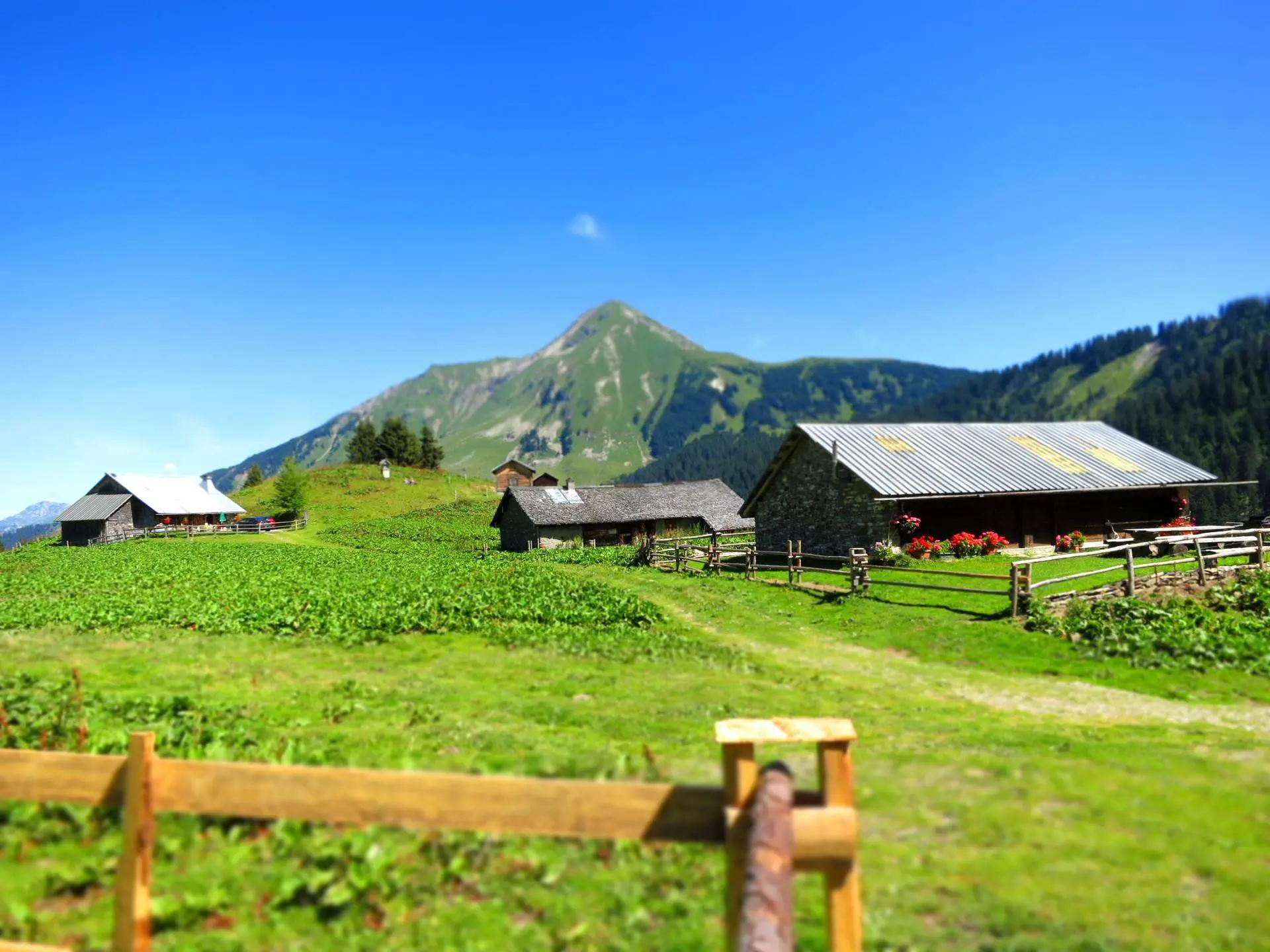
The Portes du Soleil area is located in the Haute-Savoie department of the French Alps, on the border between France and Switzerland. It links 13 resorts on a single lift pass, spread across the French side and the Swiss Alps beyond. The French resorts lie within easy access of the city of Geneva and Lake Geneva, roughly an hour to an hour and a quarter away by car. Property here is bought as a primary home, a holiday base or an investment to let.
The Portes du Soleil ski area
With around 650 km of pistes, close to 400 miles, this is one of the largest linked ski areas in the Alps. A single pass covers all of it. On the Swiss side the linked resorts include Champéry and Morgins, and the main circuit can be skied as a loop between the two countries. For an owner, a property in one French resort reaches the whole area on snow, without moving the car from one resort to the next.
The lower villages depend more on each winter's snowfall than the higher resorts, so conditions through the winter months vary across the area. The higher stations hold snow more reliably.
A year-round destination
The area works in summer as much as winter. When the snow goes the lifts and trails stay open for hiking and mountain biking, and the rivers around Morzine are used for rafting. Les Gets and Morzine run lift-served bike parks through the summer. These summer activities sit alongside the ski season rather than replacing it, with a single summer pass covering the lifts that stay open and marked walking trails running between the villages.
Water is part of what brings people in the warmer months. The resort lakes and outdoor swimming pools open through summer, and some of the higher-end chalets have a private pool.
Property in Portes du Soleil
Property across the area runs from old farmhouses through individual chalets to new-build apartments, and most properties sit in or close to the resort villages. What comes up for sale depends heavily on the resort. Sizes run from one-bedroom apartments to chalets with several bedrooms and a good deal of living space. Older farmhouses often come as renovation projects, while the new-build stock is sold ready to move into.
Morzine
Morzine is the largest resort in the area, a working town of around 3,000 residents rather than a purpose-built station. It sits at around 1,000 m, about 3,280 ft, low enough to live in year-round and high enough for a long winter season. Shops and restaurants stay open in the village centre through the year. Property runs to large individual chalets and duplex penthouses, with a smaller stock of apartments.
Les Gets
Les Gets stands at 1,172 m, about 3,845 ft, a little above Morzine. It keeps a stock of traditional Savoyard farmhouses alongside modern chalets built close to the slopes.
Avoriaz
Avoriaz was built in 1966 as a car-free, ski-in/ski-out resort, so its property is almost all apartments with very few chalets. The buildings sit directly on the snow, which suits buyers who want to step from the door onto the pistes.
Châtel
Châtel is a working village of around 1,300 residents, smaller and quieter than Morzine, towards the eastern edge of the French side. It holds a mix of older property and modern chalets, and keeps its own shops and amenities. It sits at the head of the Abondance valley, the home of Abondance cheese, and draws fewer crowds than the western resorts.
St Jean d'Aulps and La Chapelle d'Abondance
The quieter outer villages are the lower-priced way into the area. St Jean d'Aulps and neighbouring Le Biot lie in the Vallée d'Aulps below Morzine; La Chapelle d'Abondance sits in the Abondance valley beyond Châtel. They give access to the same ski area at lower prices than the headline resorts, and have a more residential feel, lived in across the year rather than only in season.
St Jean d'Aulps is known for the ruins of its 12th-century abbey, and the valley keeps a working, farmed character.
New-build and energy-efficient homes
New developments come up across the valley, and buyers who commit early can often choose finishes and layout before a build completes. They tend to follow a traditional Savoyard style rather than going up as plain modern blocks. New apartments commonly come with a balcony or terrace; new chalets with a garden and garage.
Energy ratings now shape what buyers want. Every French home carries a DPE (Diagnostic de Performance Énergétique), the national energy rating, and demand has moved towards modern, better-insulated property. For older homes the consequence is direct: a poor rating means higher heating costs and, often, a property that is harder to let.
The Portes du Soleil property market
Chalets for sale in Portes du Soleil vary in price greatly depending on size and location, and the largest chalets in Morzine can pass millions of euros. Apartments start well below the chalet range, and a renovated older chalet can sit anywhere within it depending on its condition.
Three things move a price more than any other: altitude, how close the property sits to a lift, and the standing of the resort. A prime location within walking distance of a main lift carries a premium over something a short drive out.
Demand across the area has been steady, and high-end chalets in Châtel and the outer valleys have appreciated over time. Where access and snow are reliable, prices look likely to hold.
Investment and rental potential
The two seasons are what make the rental case. Tourist demand runs through both winter and summer, so a property can be let across much of the year rather than for a single season, and an owner is not tied to the ski weeks alone. Rental yields here have held up well.
Some owners use a leaseback arrangement, letting the property to a management company in return for rental income, with personal use of the property then limited to set periods.
Catered chalets and ski-in apartments fill most readily in winter, while the lakes and bike trails carry the summer bookings.